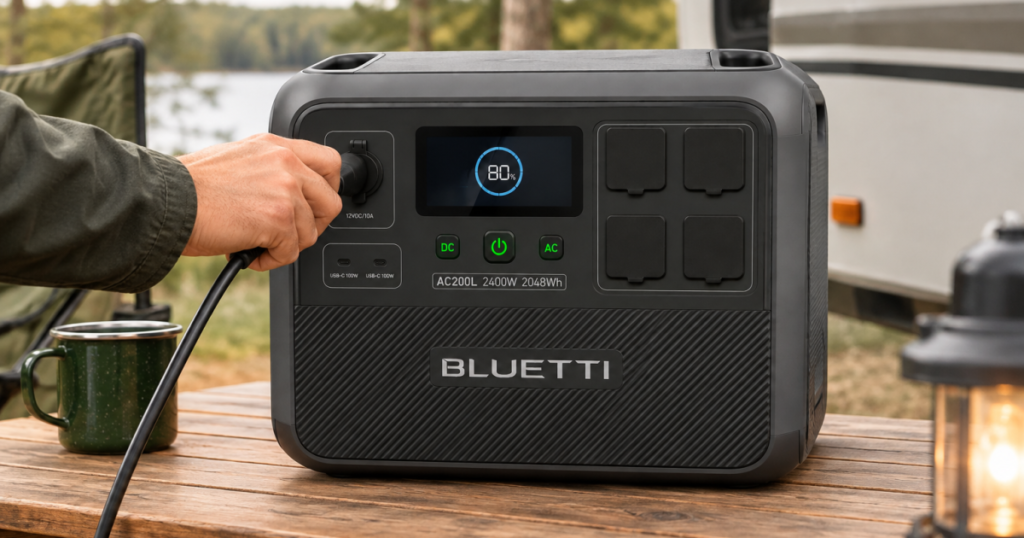
When the fridge, router, work laptop, camp kitchen, or RV gear needs quiet power, the BLUETTI AC200L lands in the serious middle ground: bigger than a weekend gadget charger, but still portable enough to move when the plan changes. This BLUETTI AC200L review looks at whether its 2048Wh capacity, 2400W AC output, expandable battery support, and 62.4 lb weight add up to a smart buy for real backup and off-grid routines.
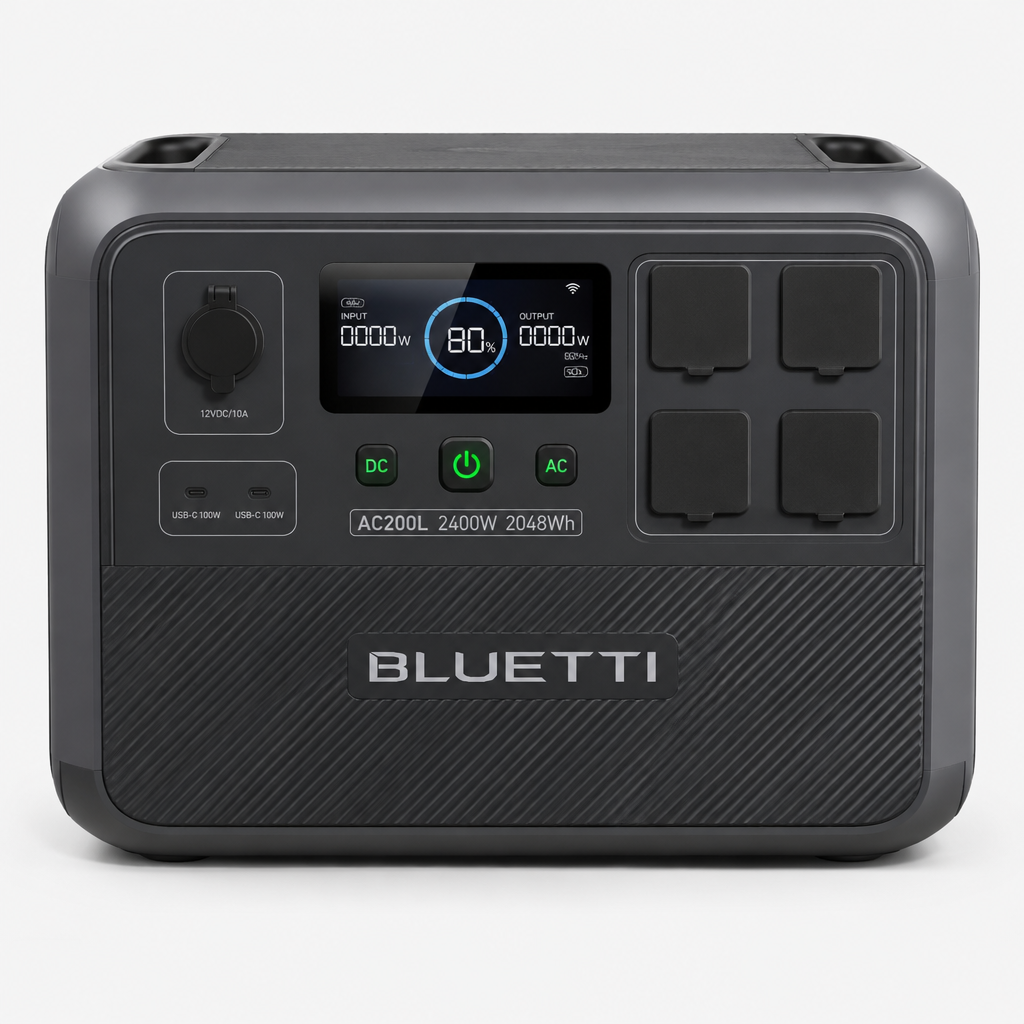
BLUETTI AC200L
Best for managed 120V backup loads where capacity, output headroom, and future battery expansion matter more than easy carrying
The short editorial read: the BLUETTI AC200L is easy to recommend for people who want a capable 120V power station for outage essentials, RV days, and solar-assisted camping. It is less compelling if you need something lightweight enough to carry often or a 240V split-phase setup for larger home systems.
Transfer-switch, panel connection, and any household wiring work should be handled by a qualified electrician in compliance with local electrical codes and safety requirements. Plug-in portable use is a different job from integrating a battery station with home circuits.
Pros & Cons
Pros
- 2048Wh capacity gives it a serious energy reserve for managed outage, RV, and camp loads.
- 2400W continuous AC output provides more headroom than smaller station classes.
- 1200W maximum solar input makes solar a meaningful recharge path, not just a token feature.
- Expansion support with B210, B230, or B300 batteries gives owners a clear growth path.
Cons
- At 62.4 lb, it is better as a movable base station than a frequent carry unit.
- 120V-only output limits its role for buyers who need 240V split-phase backup capability.
Product Details
- Product: BLUETTI AC200L portable power station
- Battery capacity: 2048Wh
- Continuous AC output: 2400W
- Weight: 62.4 lb
- Battery chemistry: LiFePO4
- Maximum solar input: 1200W
- AC recharge time: 1.5 hours
- Expansion support: Expandable with up to 2 B210, 1 B230, or 2 B300 batteries
- Output scope: 120V only; no 240V split-phase bonding
- Backup switching: UPS mode with 20ms switching time
Where the AC200L makes the most sense
The best reason to look at the AC200L is its balance of battery size and AC output. A 2048Wh station gives you enough energy to think in useful chunks of time rather than quick top-offs. That matters when you are trying to keep internet gear alive through an outage, run lights after dark, charge camera and laptop gear at a field site, or keep a compact camp setup comfortable without a gas generator humming in the background.
The 2400W continuous AC output is the other half of the story. Capacity tells you how much energy is stored; output tells you what kinds of loads the inverter is meant to handle at once. BLUETTI’s listed 2400W output gives the AC200L more headroom than many smaller 1kWh-class stations, which can make it a better fit when several everyday devices are sharing the same battery. That does not mean every appliance combination is sensible, but it does move this model beyond phone-and-lantern duty.
For runtime planning, keep the math conservative. The printed 2048Wh capacity is the starting point, not a guaranteed amount delivered to every device. AC inverter losses, standby draw, device cycling, temperature, and how hard you push the station all affect the real result. A steady 100W desk setup is a very different load from a cycling refrigerator or a cooking appliance that pulls hard for short bursts. If you want to model those trade-offs before buying, the AC200L entry in the Runtime Finder is the cleaner next step.
The ownership trade-off is weight, not complexity
At 62.4 lb, the AC200L is portable in the power-station sense, not in the casual one-hand errand sense. This is a unit you can move from garage shelf to vehicle, from RV storage bay to campsite table, or from a home office to the kitchen during an outage. It is not the model most people will want to carry across a field every afternoon just because the sun moved.
That weight is not automatically a drawback. It is the physical cost of buying into a 2kWh-class station with higher AC output and expansion potential. The decision is really about how often you expect to move it. If the AC200L will usually sit near the loads it supports, the weight is manageable. If your plan involves frequent stairs, crowded event spaces, or solo loading into a tall vehicle, the heft becomes part of the daily ownership experience. Batteries are wonderfully quiet, but they are not weightless; this one has a bit of suitcase-with-books energy.
Solar and recharge flexibility give it a long-weekend shape
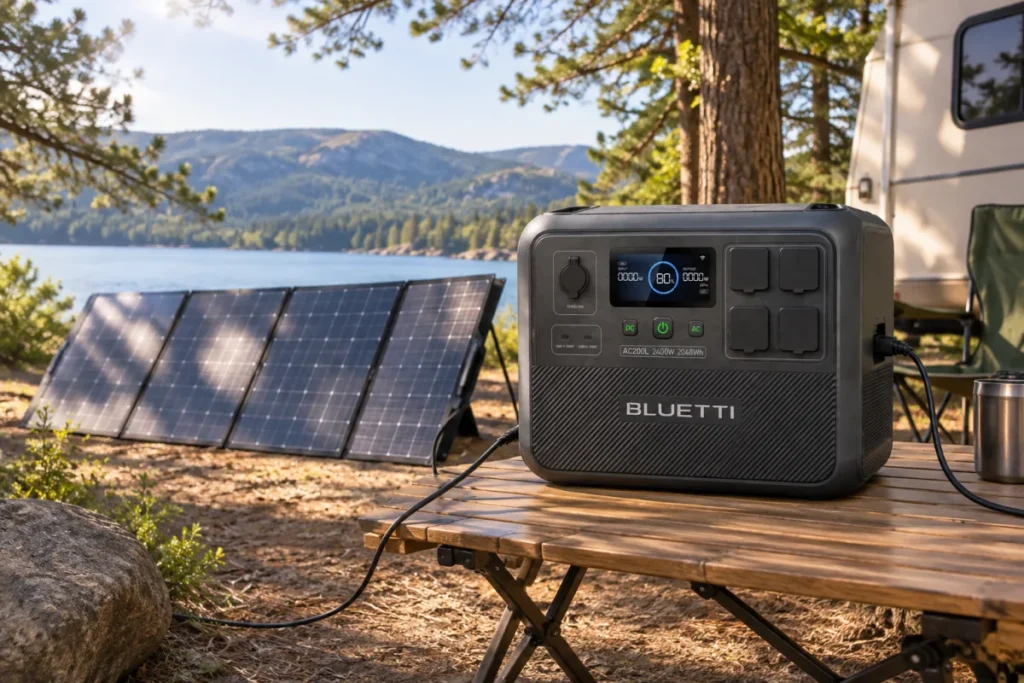
BLUETTI lists a maximum solar input of 1200W and an AC recharge time of 1.5 hours. Those two figures matter because a large power station is only as useful as your ability to put energy back into it. Fast wall charging is helpful before a storm, before a road trip, or between event days. High solar input is useful when you are trying to stretch stored energy across a longer stay where grid power is not part of the plan.
Solar results are always field-dependent. Panel angle, shade, heat, cable setup, and time of day can turn a neat specification into a messier real-world number. The practical takeaway is not that you should expect perfect solar intake all day; it is that the AC200L has enough listed solar-input headroom to make solar a serious part of the charging plan rather than a token add-on.
The 1.5-hour AC recharge figure also changes how you might use the station at home. A model that can refill quickly from the wall is easier to keep ready without turning battery management into a hobby. For outage preparation, that matters. The best backup station is the one that is actually charged when the lights blink.
Expansion is the feature that keeps it from feeling boxed in
The AC200L supports expansion with up to 2 B210 batteries, 1 B230 battery, or 2 B300 batteries. That gives it a growth path for owners who start with the main unit and later realize their loads are more demanding than expected. Expansion support is especially useful when your use case shifts from “keep the router and phones alive” to “support the fridge, internet, lighting, and a work setup in rotation.”
The important distinction is that expansion increases stored energy; it does not turn the AC200L into a different category of electrical system. The unit is listed as 120V only, with no 240V split-phase bonding. That makes it a strong candidate for many plug-in backup and mobile-power jobs, but not a substitute for a 240V-capable home backup platform when that is the requirement.
That 120V limit is not a flaw so much as a boundary. It keeps the AC200L in the world of portable station ownership: plug-in appliances, electronics, lighting, communication gear, RV use, camping comfort, and managed outage loads. If your priority is powering large 240V equipment or a more integrated whole-home setup, you are shopping in a different lane.
UPS mode: useful, but not magic
BLUETTI lists UPS mode with a 20ms switching time. For a home office, network gear, or a small powered workspace, that feature can be appealing because it gives the station a role beyond occasional emergency use. A battery that can sit in a planned backup position is easier to justify than one that only comes out when everyone is already looking for flashlights.
Still, the sensible framing is important. UPS-style switching is not the same as making a life-safety guarantee, and it should not be treated as a promise for medical continuity. For everyday electronics and continuity-minded setups, though, it adds practical value. It makes the AC200L more than a box of stored watt-hours; it becomes part of a prepared workflow.
How it compares with the size class around it
The AC200L sits above lighter 1kWh-class stations and below larger, heavier backup systems that chase whole-home ambitions. That middle position is exactly why it is interesting. Smaller models are easier to carry and often plenty for a laptop, phones, lights, and a modest camp night. The AC200L is for the buyer who has already decided that a small station feels cramped once the fridge, router, monitor, or RV gear enters the plan.
Against bigger home-backup-focused units, the AC200L’s limitation is its 120V-only output. Larger systems that support 120/240V output can make more sense when the goal is broader home integration, but they usually bring more weight, more cost, and more planning. For many owners, a disciplined 120V load plan is the smarter move: protect food, stay connected, keep a workspace running, and avoid trying to power everything at once.
If you are still choosing between capacity classes, use the Portable Power Station Runtime Finder to compare realistic loads before settling on a size. The AC200L looks strongest when your actual device list justifies a 2kWh station and you have a realistic place to store and move it.
Verdict
Score: 8.9/10
The BLUETTI AC200L is a strong 2kWh-class portable power station for buyers who want meaningful 120V backup capacity, higher AC output, quick wall recharging, solar input headroom, and an expansion path. The score is driven most by its 2048Wh capacity, 2400W continuous AC output, and flexible battery expansion support.
The main compromise is physical and electrical scope. At 62.4 lb, it is better treated as a movable base station than an easy carry-around unit. And because it is 120V only with no 240V split-phase bonding, it fits managed plug-in backup loads better than ambitious whole-home plans. For outage essentials, RV power, camp comfort, and serious mobile work, that is a very useful lane to be in.
BLUETTI AC200L
Best for managed 120V backup loads where capacity, output headroom, and future battery expansion matter more than easy carrying
You might also like: Jackery HomePower 1000 Plus v2.