
Before you buy a bigger battery or pack another solar panel, measure a power load with the gear you already plan to run: the refrigerator you want to protect, the router that keeps messages moving, or the camp kitchen that makes a weekend feel civilized. A few real numbers will tell you more than a product page full of perfect-condition runtimes.
Any connection between a power station and household circuits, including transfer-switch or inlet work, should be handled by a qualified electrician and comply with local electrical codes and safety requirements.
The big picture
A starter power plan needs three numbers: how many watts your devices use while running, how many hours you need them, and how much reserve you want for losses and surprises. The simple formula is watts multiplied by hours equals watt-hours. If a device cycles on and off, such as a refrigerator, a plug-in energy meter is better than the nameplate because it captures real behavior over time.
For portable power stations, watt-hours are the fuel tank. AC output is the size of the outlet. Recharge method is how you refill the tank. A setup that looks large on capacity can still be frustrating if it cannot handle startup surge, takes too long to recharge, or weighs too much to move where you actually need it.
This is also where priorities matter. A phone, lantern, router, and small fan may feel more valuable during a short outage than trying to power every appliance at once. For a more comfort-first way to think about backup loads, the site’s piece on small comforts during outages is a useful companion.
What to measure first
Start with one scenario, not your whole life. Pick the load that would make the biggest difference if outlets disappeared for a night, a workday, or a weekend.
- Refrigerator backup: Measure the refrigerator for a full 24-hour period if you can. Fridges cycle, so a five-minute reading is not enough. The result may appear as kilowatt-hours; multiply by 1,000 to get watt-hours.
- Router and modem backup: Measure the modem, router, mesh node, and any small network gear together. These are usually steady loads, so a shorter reading can still be useful, but longer is better if your network includes extra hardware.
- Campsite load: List every item you expect to run: cooler, lights, phones, camera batteries, laptop, water pump, fan, or small cooking appliance. For each one, estimate hours of use instead of assuming it runs all day.
A plug-in meter such as the P3 International P4400 Kill A Watt is the classic low-drama tool for this job. Plug the meter into the wall, plug the device into the meter, and let it record the energy used. For devices that charge by USB-C or DC, use the best rating information available and keep a healthy reserve, because conversion losses and charging behavior can vary.
Turn the reading into a starter plan
Once you have a measured or estimated watt-hour number, build the plan in this order.
1. Convert everything to watt-hours
If your refrigerator uses 1.2 kWh in 24 hours, that is 1,200 Wh before losses. If your network gear averages 18 W and you want 12 hours of internet, that is 216 Wh before reserve. If camp lights use 20 W for five evening hours, that is 100 Wh.
2. Add a realistic reserve
For AC-powered loads, plan extra capacity for inverter losses, idle draw, temperature, battery age, and the fact that you may not want to drain the station completely. A conservative starter reserve of roughly 15% to 25% is a useful planning habit. It is not a promise of runtime; it is a buffer against the real world.
3. Check output separately from capacity
Capacity tells you how long you might run. Output tells you whether the station can run the device at all. A refrigerator, power tool charger, or appliance with a compressor may demand more at startup than it uses while cruising. The station’s continuous AC output and surge capability both matter, and the device manual is the safest place to verify requirements.
4. Decide how you will recharge
A measured load is only half the plan. If the refrigerator uses a meaningful chunk of the battery each day, you need a refill strategy: wall charging before the storm, vehicle charging during travel, solar in good sun, or a second station if redundancy matters more than one large battery.
Three starter plans from real-life scenarios
The fridge-first outage plan
Measure the refrigerator for 24 hours, then treat that number as your daily food-protection budget. If the meter shows 1,200 Wh per day, a station with 1,200 Wh of advertised capacity is not a true 24-hour plan after losses and reserve. You would either need more capacity, a rotating schedule, a recharge path, or a smaller essential-load plan.
A smart fridge plan often avoids running everything continuously. Keep the doors closed, chill food before bad weather when possible, and use the power station during the periods that matter most. Do not assume a battery station replaces a whole-home system; it is better at targeted backup than unlimited normal living.
The router-and-comms plan
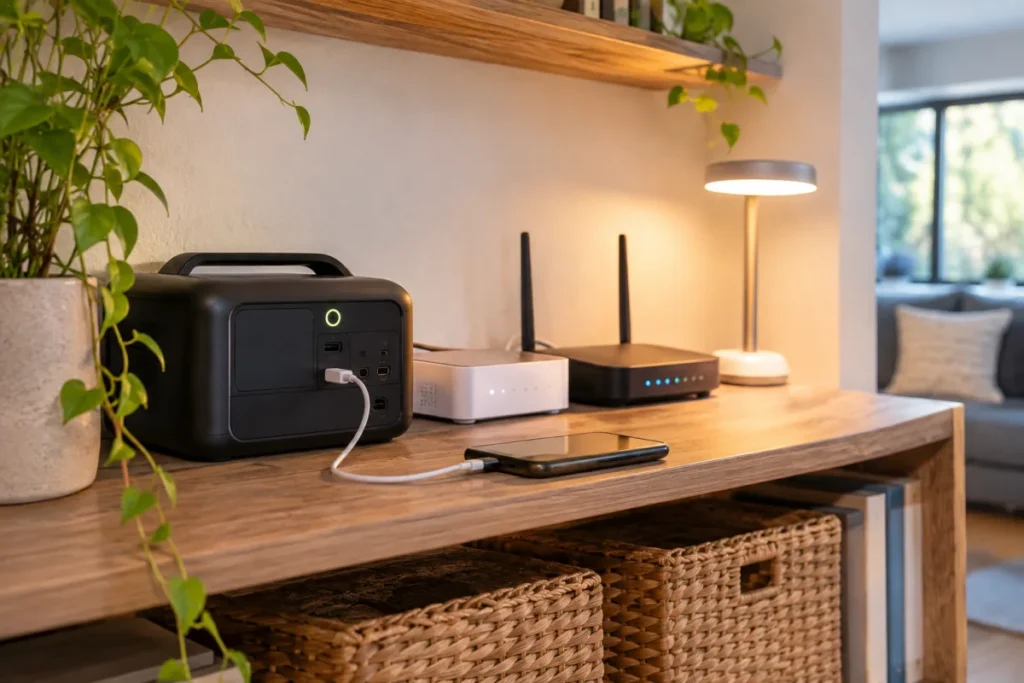
For short outages, internet gear can be one of the most satisfying loads to protect. Measure the modem and router together, multiply by your target hours, then add reserve. If your setup averages 18 W and your goal is 10 hours, the base load is 180 Wh. With reserve, you might plan closer to 225 Wh or more.
This is where smaller stations and high-efficiency DC options can shine, but only if the voltage and connector needs are appropriate. Keep the plan simple: modem, router, phone charging, and one efficient light. That small stack can feel like civilization when the rest of the room is dark.
The campsite comfort plan
Camp loads are sneaky because many are optional until they are suddenly delightful. A DC cooler, string lights, camera charger, laptop, and fan can turn a basic site into a relaxed basecamp. But heating appliances, electric kettles, hair dryers, and induction cooking can burn through capacity quickly because they draw high wattage.
Build the campsite list by evening blocks: cooler for the full day if needed, lights for four hours, phones overnight, laptop for two hours, fan for sleep. Then decide what gets cut if clouds reduce solar charging or you spend less time driving than expected.
Choosing a station size without overbuying
After measuring, you can compare stations by fit instead of vibes. A compact power station can be excellent for router backup, phones, lights, and a light camp kit. A mid-size unit makes more sense when a fridge, DC cooler, laptop workday, or longer campsite stay enters the picture. Larger home-backup units help when you want more reserve, more AC output, expansion options, or longer recharge intervals, but the weight and cost trade-offs become real.
The Portable Power Station Runtime Finder is built for this step: take your measured watt-hour target, then compare capacity, AC output, weight, solar input, expansion support, and recharge path. For a carryable reference point, the Jackery Explorer 1000 v2 page is useful when you want to see how a popular portable class is organized around real selection criteria rather than just a headline capacity number.
Common mistakes that ruin the math
- Using nameplate watts as daily use: Nameplates often show maximum or rated information, not actual energy consumed across a day.
- Ignoring inverter losses: AC power from a battery is convenient, but conversion is not free.
- Forgetting idle draw: A power station left on with no meaningful load can still consume energy.
- Counting solar as guaranteed: Shade, angle, clouds, heat, and panel placement can all reduce charging compared with ideal conditions.
- Buying only for capacity: Weight, output, recharge speed, and expansion support can matter just as much.
A subtle math trap is mixing “can run” with “should run together.” A station may handle a fridge surge just fine, then get pushed near its limit when someone adds a coffee maker, microwave, or space heater for “just a minute.” High-wattage heat loads are especially brutal because they turn battery capacity into heat very quickly. If the plan is food protection and communications, write that on the plan and treat comfort appliances as optional, not assumed.
Cold and heat can also bend the numbers. Batteries generally deliver less usable energy in freezing conditions, and many stations limit charging when the battery is too cold or too hot. If the unit will live in a garage, truck, shed, or tent vestibule, build in more reserve than you would for a climate-controlled room. The same goes for solar panels left flat on the ground, partly shaded by a chair, or aimed well enough in the morning but poorly by afternoon.
Finally, watch the small accessories. Extension cords, power strips, AC adapters, and USB chargers can add clutter and tiny losses, but the bigger issue is behavior: extra open outlets invite extra loads. During a real outage or campsite reset, label one outlet group “essential” and keep the rest off until the measured priority loads are covered.
Things readers ask
How long should I measure a refrigerator?
A full 24 hours is the practical minimum because the compressor cycles, door openings vary, and room temperature changes. Longer measurement is better if the weather or household routine is unusual.
Can I estimate instead of measuring?
Yes, but treat estimates as a starting point, not a guarantee. Measuring is more reliable for cycling appliances and mixed campsite loads because it captures actual use patterns.
Should I buy one large station or two smaller ones?
One larger unit can simplify high-capacity backup and reduce cable clutter. Two smaller units can add redundancy and let you split loads between the kitchen, router, vehicle, or tent. The better choice depends on your measured loads and how often you need to move the gear.
Why it matters
Measured loads take the fog out of portable power. Instead of asking whether a battery is “big enough,” you can ask sharper questions: Will it run my measured refrigerator day with reserve? Will it keep the router alive through an evening outage? Can it support my camp cooler and lights without turning every sunny hour into a charging emergency?
That shift is the whole win. A starter plan does not need to power everything. It needs to protect the loads that make the situation calmer, safer, more connected, and more comfortable.